Wage Garnishments on Your Pay Stub, Explained
Prepared by Paystub Pilot
Compliance and legal research
Reviewed against CCPA Title III, IRS Pub 1494, and DOL garnishment fact sheet.
A garnishment on your pay stub is a court or agency order your employer is required to follow. Compare garnishment types, the federal limits that protect take-home pay, and what to do if the amount looks wrong.
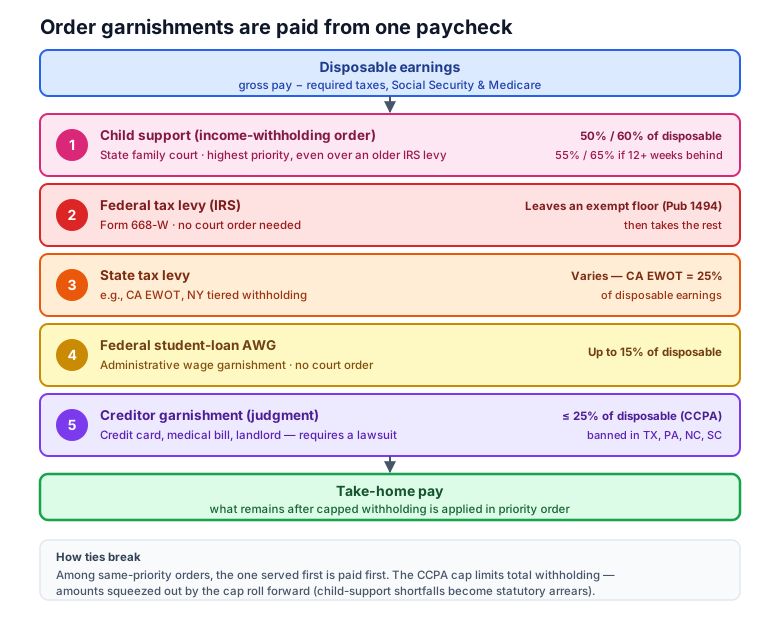 Priority waterfall showing the order garnishments are paid from one paycheck: child support first, then federal tax levy, state tax levy, federal student-loan AWG, and creditor garnishments, each with its CCPA or statutory cap, leaving take-home pay
What a Garnishment Is and Why It Appears on Your Stub
A wage garnishment is a court or agency order directing an employer to withhold a portion of an employee's paycheck and remit it to the issuer of the order. The employer is required to comply, the employee cannot negotiate the amount, and the deduction shows up as a separate line on the paystub, labeled by purpose.
Unlike voluntary deductions (health insurance premiums, 401(k) contributions, employee-paid life insurance), which the employee can elect or cancel, a garnishment runs on a court order or administrative writ and persists each pay period until the underlying debt is satisfied or the order is released. Employers face their own penalties for failing to comply, which is why the deduction is not negotiable at the employer level, even when the resulting paycheck creates hardship for the worker.
The sections below cover the four most common garnishment types: child support, federal and state tax levies, federal student-loan administrative wage garnishment, and creditor garnishments arising from civil judgments. Bankruptcy wage orders are handled separately by the bankruptcy court and aren't covered here.
Child Support Withholding
Child support is the most common garnishment and has top priority when multiple orders compete for a single paycheck. State family courts issue child support orders, which state enforcement agencies then pursue. Once your employer receives an income-withholding order (IWO), federal rules (42 U.S.C. §666(b)(6) and 45 CFR §303.100) require the employer to begin withholding promptly, typically the first full pay period after receiving the IWO (exact timing is set by state law), and to remit the withheld funds to the state disbursement unit within seven business days of each pay date. The state disbursement unit then forwards funds to the recipient on its own schedule, which varies by state. Check your state's child support enforcement portal for the timeline.
On your pay stub, look for "Child Support," "CS Withholding," or a state-specific label like "CA CSE." The withholding comes from disposable earnings: gross pay less required taxes, Social Security, Medicare, and mandatory retirement contributions (not 401(k) or health premiums). Under the Consumer Credit Protection Act Title III (CCPA, 15 U.S.C. § 1673), child support caps at 50% of disposable earnings if you support another spouse or child, or 60% if you don't, rising to 55% or 65% if you're 12+ weeks behind. State laws often set lower caps, and whichever is lower applies, so always check your state's child support withholding rules alongside federal law.
Multiple child support orders split the withholding proportionally by amount owed, with no ability to prioritize one case over another. When combined orders exceed the CCPA limit, unpaid portions roll into arrears that persist until capacity opens up. Your stub should itemize each order separately; if it doesn't, request a breakdown from payroll.
Federal Tax Levies
An IRS levy is how the agency collects back taxes directly from a paycheck. Rather than operating as a percentage, it leaves the worker with an exempt amount that varies by filing status and number of dependents, and the IRS takes everything above that floor. The exempt amounts are published each year in IRS Publication 1494 (the 2026 edition was released in December 2025). For 2026, a single filer with no dependents has an exempt amount of roughly $310 per week, and the floor scales up with additional dependents and different filing statuses. If a worker's family status changes during the year (marriage, birth of a child, additional dependent), they can request a recalculation through Form 668-W Part 3.
The pay stub line reads "Federal Tax Levy," "IRS Levy," or similar. Your employer calculates it using Form 668-W and Pub 1494 tables. You'll receive both documents plus Form 668-W Part 3 (Statement of Exemptions), which you must return within three business days. Skipping that step locks in maximum withholding defaults, so returning it on time is the only opportunity to reduce the levy based on your household and filing status.
An IRS levy stays until the debt is paid, the 10-year statute of limitations expires, you get an installment agreement, or the IRS releases it. Calling the IRS to propose an installment agreement is the fastest path to relief; the levy typically lifts within a week.
State Tax Levies
State levies follow the same general logic as federal levies but differ by state. Some use a percentage of disposable earnings (like child support); others use a fixed exempt floor (like the IRS). California's EWOT (Earnings Withholding Order for Taxes) takes up to 25% of disposable earnings. New York uses tiers that scale with wage level.
State levies appear as "CA EWOT," "NY State Tax Levy," or "State Tax Lien." Federal levies take priority when both are active, and the state gets what's left, which can be nothing.
Student Loan Garnishment
The federal government can garnish for defaulted federal loans without a court order through Administrative Wage Garnishment (AWG). The cap is 15% of disposable earnings or the excess over 30× the federal minimum wage, whichever is lower. You get a 30-day notice and can request a hearing to contest the amount or claim hardship.
The line reads "Federal Student Loan" or "ED AWG." Private loans don't use AWG; lenders must sue, get a judgment, then pursue a creditor garnishment. If your stub shows "student loan garnishment" but you only have private loans, it is a creditor garnishment and should be labeled as such.
To stop AWG: rehabilitate the loan (nine consecutive on-time payments), consolidate into a Direct Loan, pay in full, or prove hardship at a hearing. Deferments and forbearances don't auto-stop garnishment; you must act.
Creditor Garnishments (Credit Cards, Medical Bills, Judgments)
Creditor garnishments start with a lawsuit. A credit card company, hospital, landlord, or private lender sues, wins judgment, then gets a garnishment order. The creditor cannot act unilaterally; a court order is required. The timeline runs 60 to 120 days from filing to first deduction.
Under CCPA Title III, creditor garnishments cap at the lesser of 25% of disposable earnings or the amount by which disposable earnings exceed thirty times the federal minimum wage. Many states impose a lower cap, and whichever number is more protective applies. CCPA also prohibits firing an employee on the basis of a single garnishment; several states extend that anti-termination protection to multiple garnishments. Texas, Pennsylvania, North Carolina, and South Carolina prohibit creditor garnishments on consumer debt outright (with narrow exceptions for unpaid rent, taxes, and some judgments). A creditor garnishment appearing on a stub in those four states is either for an exempt category of debt or improper, and is worth disputing immediately.
The line reads "Garnishment," "Writ," the case number, or the creditor's name. The amount matches the court order. It continues until the judgment plus interest and costs are paid, the creditor releases it, or the judgment expires (10–20 years by state).
How Multiple Garnishments Interact
When more than one garnishment hits the same paycheck, the order in which the employer satisfies them is set by a combination of federal rules and the order in which the underlying orders were served. Child support orders generally take first priority. A support order entered before an IRS levy is exempt from that levy under 26 U.S.C. §6334(a)(8), so the employer keeps funding it in full; when a support order arrives after a levy is already in place, the levy technically has priority, but the employer can contact the IRS, which commonly agrees to let the support obligation be paid first. State levies, student-loan AWG, and consumer-creditor garnishments fall after federal priorities. Among same-priority orders, the order served first has priority, and the employer applies the others to whatever capacity remains under the CCPA cap.
The behavior of unsatisfied amounts depends on the garnishment type. With child-support orders, the unpaid portion of a current obligation accumulates as statutory arrears under the underlying child-support order, which is why workers with multiple support orders can see large balances grow even while making regular deductions. With consumer-creditor garnishments, an amount that the CCPA cap pushed out of a given paycheck doesn't accrue as a separate statutory arrear; the underlying judgment continues to bear interest and the garnishment simply takes longer to satisfy.
What to Do If a Garnishment Looks Wrong
If you see a garnishment you don't recognize, request a copy from payroll; employers must provide it. Verify three details: Is the debt yours? Does the amount match the order? Is the start date correct? If the debt is unknown to you, you may be a victim of identity theft or mistaken identity, and you should contact the issuing court or agency immediately. If the amount is wrong, most garnishments include a hearing right explained in the original notice. If withholding continues after payoff, your employer must stop within one pay period of receiving a release.
CCPA Title III bars an employer from firing an employee on the basis of a single garnishment, and several states extend that protection to multiple garnishments. Termination tied to a garnishment is worth a conversation with an employment lawyer. Keep copies of every garnishment order, every wage statement showing the withholding, and all correspondence with the issuing court or agency, because that file is what proves both the amount and the timing if the order is later disputed.