How to Read Your Pay Stub: Complete Breakdown of Every Line
Prepared by Paystub Pilot
Payroll and tax research
Reviewed against IRS Pub 15 and a real ADP, Gusto, and Paychex stub.
What every line on your pay stub means, how the stub differs from the paycheck itself, and how to check the numbers: gross pay, withholding, FICA, deductions, and year-to-date totals.
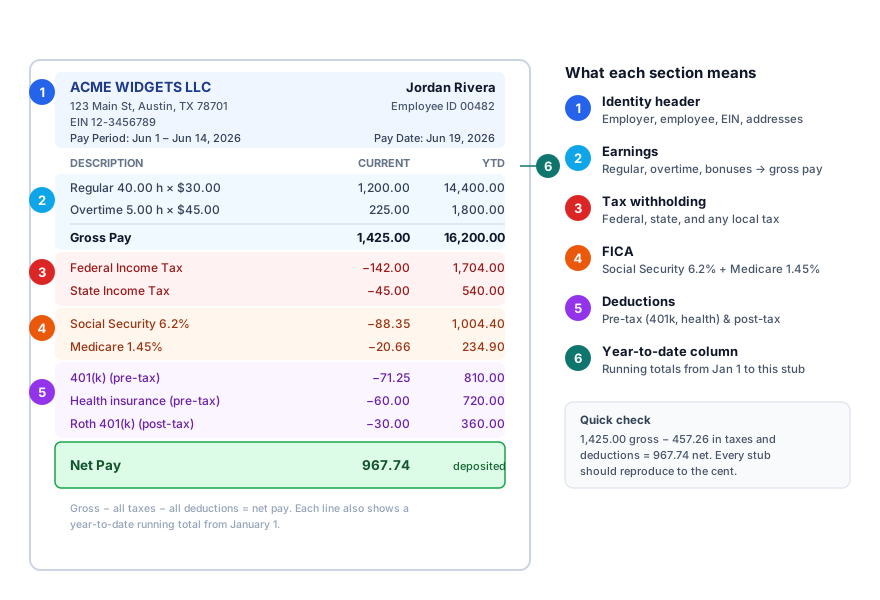 Annotated sample pay stub with six numbered regions: identity header, earnings ending in gross pay, federal and state tax withholding, FICA (Social Security 6.2% and Medicare 1.45%), pre-tax and post-tax deductions, and the year-to-date column, with a legend explaining each section
Pay Stub vs Paycheck: Which Document Is Which
Every payday produces two things. The paycheck is the payment itself: the printed check or, far more often now, the ACH direct deposit that lands in your account. On its own it tells you the amount, the date, and who paid you, and the amount is net pay, what's left after taxes and deductions came out somewhere upstream.
The pay stub (also called a paycheck stub, earnings statement, or wage statement) is the breakdown that explains how that net figure was reached: gross earnings, every tax withheld, every deduction, and year-to-date totals for each line. Everything below this section is about reading the stub.
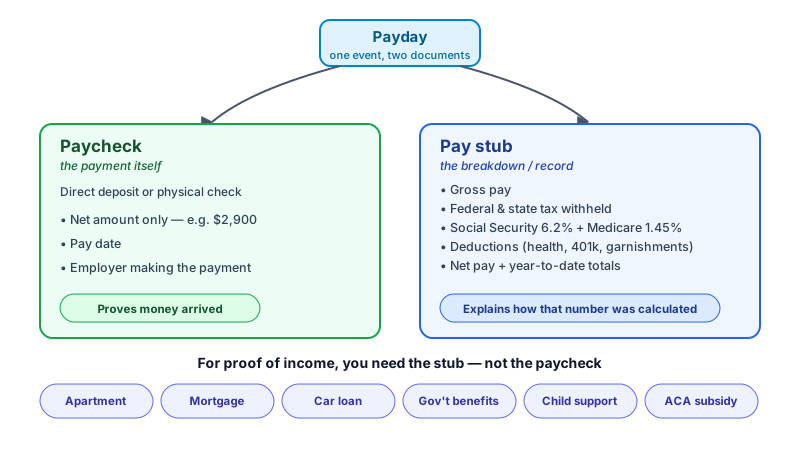 Diagram showing one payday produces two documents: the paycheck (the payment, showing only net) and the pay stub (the breakdown showing gross, taxes, deductions, net, and year-to-date), with the stub required for proof of income
Where the difference bites: landlords, mortgage underwriters, auto lenders, and benefit agencies ask for stubs, not deposit records, because a deposit shows money arrived while a stub shows gross, source, and YTD, the inputs they qualify you on. At tax time, the final stub's YTD figures are what you reconcile against the W-2. For budgeting, the stub is what explains why a $4,000 biweekly gross becomes a $2,900 deposit. And in a wage-and-hour dispute, the stubs (hours, rate, overtime calculation, each deduction) are the documentary backbone; a bank record isn't.
Whether you're entitled to a stub at all is mostly state law. The FLSA requires employers to keep payroll records (DOL Fact Sheet 21, 29 CFR Part 516) but not to hand you a copy. Most states fill that gap with wage-statement statutes: California Labor Code §226 spells out exactly which fields an itemized statement must carry, and New York §195.3 and Oregon ORS 652.610 work similarly. Texas is the notable exception, since its rule doesn't reach employers covered by the federal FLSA, which is most of them, and a small group of states have no requirement at all. Self-employed workers and contractors get neither document from a client; what they produce for a reviewer is a self-employment income summary, which is a different thing from an employer-issued stub.
The Top Section of Your Pay Stub: Personal Information
The stub opens with your name, employee ID, and the company name. Confirming those details match your tax records sounds tedious until a misspelled name or wrong employee number turns up on a W-2 and creates real friction with the IRS or a mortgage underwriter.
Pay-period dates and pay date sit near the top. They aren't the same thing: the pay period is when the work happened, while the pay date is when the money lands. Federal tax law follows the pay date. A check dated December 28 for late-November work counts as December income, and a check dated January 5 for late-December work is next-year income. See pay period vs pay date for the year-end edge cases. The pay date also drives FICA wage-base counting and 401(k) deferral limits, which matters for anyone who joined mid-year or changed jobs (each employer tracks its own YTD count and can't see what the previous employer already withheld).
Verify the employer EIN and business address while you're at it. Workers holding two jobs at once should compare the EIN on each stub, because the rare payroll error involves a parent company's name appearing on a stub that should have come from a subsidiary with a different EIN.
Understanding Gross Pay and Income Types
Gross pay is total earnings before any deduction. A $50,000 salary paid biweekly shows $1,923.08 per check in gross. Every tax and benefit line on the stub starts from this baseline.
The gross section usually breaks out regular pay from overtime (1.5x the regular rate for non-exempt hours over 40 in a workweek), plus bonuses, commissions, tips, or shift differentials when they apply. Gross pay and the numbers on a W-2 are not the same thing. Federal taxable wages (W-2 Box 1) are gross pay less pre-tax items such as traditional 401(k) deferrals and Section 125 health insurance premiums. Social Security wages (Box 3) and Medicare wages (Box 5) are gross less Section 125 premiums (which do reduce FICA wages), but not 401(k) deferrals (which don't). The three boxes intentionally show different numbers for the same paycheck.
Practical consequence: FICA is computed on Box 3 / Box 5 wages, not Box 1. Pre-tax 401(k) contributions reduce Box 1 but do nothing to the FICA line. Pre-tax health premiums reduce all three boxes. Gross-pay errors are rarer than deduction errors, but when they happen they affect every downstream number, so it's the line worth checking first.
Decoding Tax Withholdings: Federal, State, and Local Taxes
Federal income tax withholding is usually the single largest line on the stub. The W-4 controls it: filing status, dependents, "other income" entries, and any extra withholding requested all feed into the 2026 IRS withholding tables. More dependents claimed pulls less tax per check; "extra withholding" requested on Step 4(c) adds a flat dollar amount to every paycheck.
State tax follows similar logic but with bigger swings. Nine states withhold zero on wages: Alaska, Florida, Nevada, New Hampshire, South Dakota, Tennessee, Texas, Washington, and Wyoming. In those states, there's simply no state-tax line on the stub. Every other state withholds at either a flat rate (Illinois at 4.95%, Indiana at 2.95%, Pennsylvania at 3.07%) or under graduated brackets (California, New York, New Jersey, and most others).
Some stubs add local or city tax. New York City residents see a separate NYC withholding line. Philadelphia residents see the city wage tax at 3.735% (3.425% for non-residents) effective July 1, 2026, stepping down each fiscal year under the city's five-year rate-cut plan. Maryland counties piggyback on the state return. The combined federal-plus-state-plus-local total is the headline number underwriters and mortgage lenders use when they project annualized income from a single pay stub.
FICA Taxes: Social Security and Medicare
FICA (Federal Insurance Contributions Act) is two taxes that travel together on the stub: Social Security at 6.2% and Medicare at 1.45%, for 7.65% total on the employee side. Social Security stops at the annual wage base ($184,500 for 2026, set by the SSA in October each year as part of the COLA announcement). Medicare runs on every dollar with no cap, and the 0.9% Additional Medicare Tax adds a third tier once wages cross $200,000 single or $250,000 MFJ. The employer matches 6.2% Social Security and 1.45% Medicare, but does not match the 0.9% surtax.
Social Security funds retirement, disability, and survivor benefits. Workers earn credits by paying into the system: 40 credits are required to qualify for retired-worker benefits, which usually takes about 10 years of contributions. The retirement benefit itself is calculated on the highest 35 years of indexed earnings (years with no earnings count as zeros), so a long, steady earnings history generally produces a larger benefit, all else equal.
Medicare funds hospital insurance for Americans age 65 and older, plus certain younger people with disabilities. The 1.45% line on each stub is small in any individual paycheck but represents real lifetime contributions: a worker earning a $60,000 salary for 35 years pays roughly $30,000 in employee Medicare tax (and the employer matches with another $30,000).
Deductions Explained: Voluntary and Employer-Provided
Pre-tax deductions lower the taxable wages that drive withholding. Section 125 health, dental, and vision premiums reduce federal income tax, FICA, and state income tax all together. Traditional 401(k) and 403(b) deferrals reduce federal and state income tax but not FICA. HSA and FSA contributions follow the Section 125 pattern (most states honor federal pre-tax treatment, though a handful, including Pennsylvania, treat 401(k) deferrals as state-taxable wages).
Post-tax deductions come out of net pay after withholding has been calculated. Wage garnishments, child support orders, tax levies, post-tax Roth 401(k) contributions, and (depending on the employer) union dues all sit in this category. They reduce take-home dollar for dollar.
A $50 pre-tax deduction at a 22% federal bracket plus 5% state shaves about $36.50 off take-home, because the other $13.50 was tax that would have gone to the government anyway. A $50 post-tax deduction shaves the full $50.
Year-to-Date Totals: Tracking Your Annual Progress
Year-to-Date totals run from January 1 through the current pay period. YTD gross is what you've been paid so far. YTD federal tax, YTD state tax, YTD Social Security wages, and YTD Medicare wages all track separately. A YTD figure that's lower than expected against months elapsed is often a payroll error worth surfacing early; the IRS has a free withholding estimator that uses YTD figures as inputs.
Withholding drift is the most common YTD problem. If YTD federal tax projected forward to year-end shows a big refund, the W-4 can be updated to reduce extra withholding and recapture the cash. If it projects a balance due, the same form can add Step 4(c) extra withholding to close the gap before April.
Lenders work from YTD as the basic input for annualized income. A mortgage underwriter looks at the two most recent stubs, divides YTD gross by the fraction of the year elapsed, and uses the result as a working income estimate (cross-referenced against W-2s and verification of employment). A clean YTD column with no unexplained gaps is one of the most valuable things your pay stub can offer at loan-application time.