Gross Pay vs Net Pay: The Difference and Why It Matters
Prepared by Paystub Pilot
Payroll and tax research
Reviewed against IRS Pub 15-T and 2026 SSA wage-base figures.
Gross pay and net pay are two of the most important numbers on your pay stub. Learn what each means, what gets deducted, and how to calculate your take-home pay.
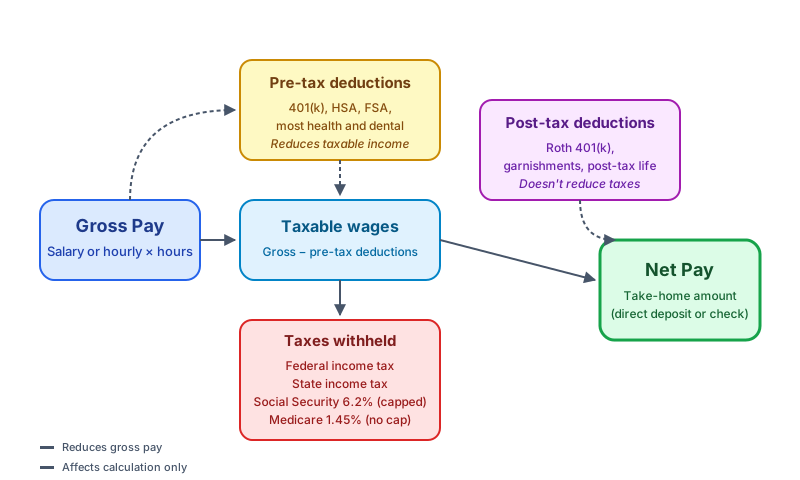
Gross Pay Explained
Gross pay is total earnings before any taxes or deductions are subtracted. It's the figure your employer agreed to pay you for the pay period. At a $60,000 annual salary paid biweekly, gross is $2,307.69 per check. An hourly worker at $25 for 80 hours sees $2,000 per period.
Beyond base wages or salary, gross pay typically includes:
- Overtime pay, normally at 1.5 times the regular rate for non-exempt hours over 40 in a workweek (state rules vary; California, Alaska, and Nevada have daily overtime thresholds)
- Bonuses (performance, signing, or holiday)
- Commissions tied to sales or production metrics
- Reported tip income for tipped workers
- Paid time off taken during the period (holiday, vacation, sick pay)
The sum of those components is gross, the top-line number on the stub.
Net Pay Explained
Net pay is what hits the bank: gross minus federal income tax, state income tax, FICA, and any benefit or retirement deductions. The same paycheck is also called take-home pay because the worker actually keeps it.
The gap between the two surprises most people the first time they see a stub. A $60,000 gross salary in California with modest benefits nets somewhere around $42,000-$45,000 once federal tax, FICA, CA state tax, CA SDI, and a health premium are taken out. The same $60,000 in Texas (no state income tax, no SDI) usually nets closer to $48,000-$50,000, a difference of several thousand dollars from a salary that looks identical on paper.
What Gets Deducted Between Gross and Net
Three categories chip away at gross pay:
Mandatory Tax Withholdings
Federal income tax withholding depends on taxable wages, pay frequency, and Form W-4 information. The 2026 individual income-tax rates run from 10% to 37%, but the marginal bracket is not the worker's overall effective rate. A W-4 can be updated when circumstances or the desired withholding change.
State income tax accounts for major differences between paychecks. Nine no-income-tax states do not impose a broad individual income tax on wages, while states such as Illinois use a flat rate and California uses graduated rates. Compare current taxable-income and withholding rules for the actual worker rather than estimating one state's annual tax from salary alone.
Social Security tax (OASDI) is 6.2% of gross up to the 2026 wage base of $184,500. Above that figure, OASDI stops for the year and the line on the stub goes to zero. Employers match dollar for dollar but don't show their match on your stub.
Medicare tax is 1.45% on every dollar with no wage cap. Combined with OASDI, FICA totals 7.65% on the employee side. Above $200,000 single ($250,000 MFJ), the 0.9% Additional Medicare Tax kicks in, raising the Medicare-only piece to 2.35% on the high-earner portion. The Additional Medicare Tax has no employer match.
Local taxes show up in pockets of the country. New York City has its own income tax. Philadelphia's resident wage tax dropped to 3.735% effective July 1, 2026, with non-residents at 3.425%. Maryland counties and Ohio school districts withhold their own piggyback rates.
Voluntary Pre-Tax Deductions
Pre-tax deductions reduce taxable income and lower federal withholding:
- Health insurance premiums: Your share of employer-sponsored medical, dental, and vision coverage
- 401(k) or 403(b) contributions: Retirement savings (traditional plans are pre-tax)
- HSA contributions: Health Savings Account deposits
- FSA contributions: Flexible Spending Account for healthcare or dependent care
- Commuter benefits: Pre-tax transit or parking allowances
Post-Tax Deductions
These come out after federal and state withholding is applied:
- Roth 401(k) contributions: Retirement savings from after-tax dollars
- Life insurance premiums: Employer-sponsored supplemental coverage above $50,000
- Union dues: Required payments for union membership
- Wage garnishments: Court-ordered deductions for child support, back taxes, or debts
Example: Gross vs Net for a $60,000 Salary
A realistic example for a single filer earning $60,000 a year in California, paid biweekly (26 periods), with a $150-per-check Section 125 health premium and 6% in a traditional 401(k):
| Line Item | Per Period | Annual |
|---|---|---|
| Gross Pay | $2,307.69 | $60,000 |
| 401(k) pre-tax (6%) | -$138.46 | -$3,600 |
| Health Insurance (pre-tax) | -$150.00 | -$3,900 |
| Federal Income Tax | -$158.46 | -$4,120 |
| California State Tax | -$53.08 | -$1,380 |
| Social Security (6.2% after §125 premium) | -$133.78 | -$3,478 |
| Medicare (1.45% after §125 premium) | -$31.29 | -$813 |
| California SDI (1.3% after §125 premium, no cap) | -$28.05 | -$729 |
| Net Pay | $1,614.57 | $41,980 |
Federal tax is computed on $60,000 − $16,100 (2026 standard deduction) − $3,600 (401(k)) − $3,900 (Section 125 premium) = $36,400 taxable. That's $1,240 (10% × $12,400) + 12% × $24,000 = $4,120, or roughly $158 a biweekly check. California state tax on the same Section-125-and-401(k)-reduced base lands around $1,300-$1,450 a year using 2026 CA brackets and the single standard deduction, before CA's personal exemption credit trims it slightly further.
Note the FICA base: a Section 125 cafeteria-plan health premium is exempt from Social Security and Medicare, so those lines (and CA SDI) are computed on gross minus the $150 premium, not full gross. The traditional 401(k) does not get that treatment — 401(k) deferrals reduce income tax but not FICA wages, which is why they're still in the FICA base.
Net-to-gross runs about 70% after retirement and benefits. Drop the 401(k) and the health premium and federal/state tax climb but the cash net rises to roughly $1,800-$1,850 a check. Different state, different W-4, different benefit elections, very different bottom line.
Where Gross and Net Actually Show Up
Budgeting is the clearest case for net: it's the only number that corresponds to actual cash. Gross is what lenders want to see (mortgage underwriters use it for both the front-end and back-end debt-to-income ratios), but day-to-day spending plans have to start from what the bank account actually receives.
Job offers are quoted in gross, which makes comparison shopping tricky. A $70K offer in Texas often nets more than a $75K offer in California once state tax and SDI are factored in, so running the numbers before signing is worth the twenty minutes it takes.
On the tax side, the W-4 is the main lever. A large refund signals over-withholding throughout the year; a surprise balance due signals under-withholding. One thing worth flagging separately: traditional 401(k) contributions reduce federal and state income tax but not FICA, so the Social Security and Medicare lines on the stub stay tied to the full gross even as retirement savings climb.
Preview the Gross-to-Net Breakdown
Create a pay-stub preview and compare gross pay, taxes, deductions, and net pay before downloading the clean PDF.