Overtime on Pay Stubs: Hourly, Salary, and Exempt Rules
Prepared by Paystub Pilot
Payroll compliance research
Reviewed against DOL FLSA overtime and exemption guidance.
Overtime should be visible and reproducible on a pay stub. Learn how regular rate, time-and-a-half, salary status, bonuses, and state rules affect the line.
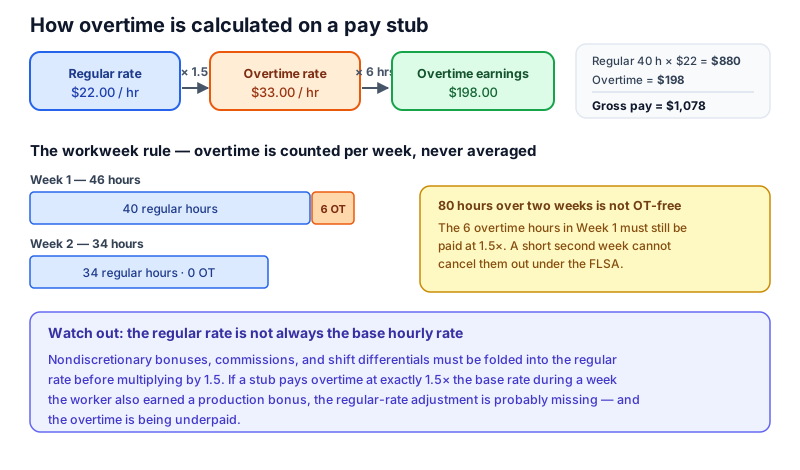
What Overtime Should Look Like on a Pay Stub
For a non-exempt hourly employee, overtime should be easy to follow:
| Line | Example |
|---|---|
| Regular hours | 40.00 |
| Regular rate | $22.00 |
| Regular earnings | $880.00 |
| Overtime hours | 6.00 |
| Overtime rate | $33.00 |
| Overtime earnings | $198.00 |
| Gross pay | $1,078.00 |
The federal baseline is one and one-half times the regular rate for hours worked over 40 in a workweek. The stub should make that math reproducible.
The Workweek Rule
The FLSA applies overtime on a workweek basis. A workweek is a fixed, recurring 168-hour period: seven consecutive 24-hour days. It does not have to match the calendar week, but once set, it has to be applied consistently.
This matters for biweekly payroll. If an employee works 46 hours in week one and 34 hours in week two, the pay period total is 80 hours. But the employee still has 6 overtime hours in week one. The employer cannot average the two weeks together to avoid overtime.
Regular Rate Is Not Always the Base Hourly Rate
Overtime is based on the regular rate, not always the simple hourly rate. The regular rate generally includes compensation for employment except amounts specifically excluded by the FLSA.
That means some bonuses, commissions, shift differentials, and incentive payments can increase the regular rate used for overtime. Discretionary bonuses and certain reimbursements may be excluded. The exact treatment depends on the payment.
If a stub shows overtime calculated at exactly one and one-half times the base rate even though the employee also earned a non-discretionary production bonus, the stub may be missing a regular-rate adjustment.
Hourly Employees
Hourly non-exempt workers are the straightforward case, and the stub should show hours, rates, and overtime earnings.
Common errors:
- Overtime hours missing entirely
- Overtime paid at straight time
- Overtime averaged across two weeks
- Shift differentials excluded from the regular rate
- Bonus overtime adjustment omitted
- State daily overtime ignored
The employee can usually audit the stub from the timecard and the rate.
Salaried Employees
Salary alone does not determine overtime status; a salaried worker can be exempt or non-exempt.
Exempt employees generally must meet salary basis, salary level, and duties tests. The job title is not enough. Calling someone "manager" or "administrator" does not make the exemption valid if the work does not meet the test.
Salaried non-exempt employees still need overtime calculations. The employer may pay a fixed salary for a set schedule, but overtime for hours over 40 in the workweek still has to be computed using the applicable regular-rate method.
State Overtime Rules
Some states go beyond the federal 40-hour weekly rule. California is the most familiar example, with daily overtime rules for many non-exempt workers. Other states have industry-specific or occupation-specific rules.
For multi-state employers, do not assume the federal rule is enough. The employee's work state can change the calculation and the wage-statement fields.
The Federal Overtime Deduction (2025–2028)
Overtime lines on the stub took on a second job starting in 2025. Under the federal "no tax on overtime" deduction, workers can deduct the premium portion of FLSA-required overtime, the "half" in time-and-a-half, up to $12,500 per year ($25,000 filing jointly), with a phase-out beginning at $150,000 of modified adjusted gross income ($300,000 jointly). The deduction runs for tax years 2025 through 2028.
For 2026, employers must report qualified overtime compensation separately, on Form W-2 in Box 12 with code TT. Only FLSA-required overtime premium counts; state daily-overtime premiums, holiday pay, and contractual premiums above the FLSA minimum do not qualify. A stub that keeps regular and overtime earnings on separate, clearly rated lines makes that year-end reporting much easier to verify.
When Overtime Is Paid
Federal DOL guidance says overtime earned in a workweek normally must be paid on the regular payday for the pay period in which the wages were earned. Some situations allow corrections or delayed computation, but straight-time wages should not be held back while payroll figures out the overtime premium.
California's guidance similarly distinguishes regular wages from overtime corrections: overtime wages earned in one payroll period must generally be paid no later than the payday for the next regular payroll period.
How to Check the Stub
Start with four numbers:
- Workweek hours
- Regular rate
- Overtime hours
- Overtime rate
Then ask whether any bonus, commission, or shift differential should be in the regular rate. Compare the result to gross pay. If gross pay does not equal regular earnings plus overtime earnings plus other earnings, ask payroll to show the calculation.
Create or review a pay stub with separate regular and overtime lines so the math stays visible.