How to Calculate Take-Home Pay: 2026 Worked Examples
Prepared by Paystub Pilot
Payroll and tax research
Fact-checked against IRS Pub 15-T (2026).
Learn the formula for calculating your take-home pay from your salary. Includes real examples at $40K, $75K, and $120K annual salary.
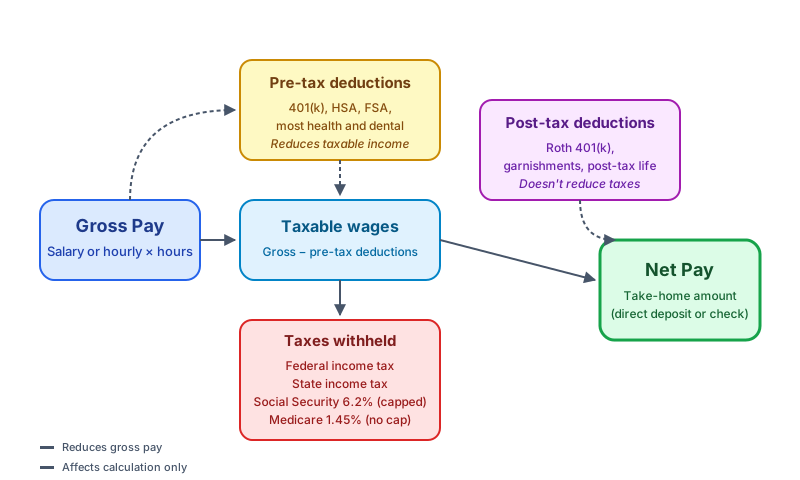 Diagram showing how gross pay flows through pre-tax deductions, federal and state income tax, FICA, and post-tax deductions to arrive at net take-home pay
How to Calculate Take-Home Pay: The Basic Formula
Take-home pay is your gross income minus all deductions and taxes: gross pay, minus federal income tax, minus state income tax, minus FICA (Social Security and Medicare), minus pre-tax deductions equals what hits the bank. The work is in figuring out what each line actually withholds, which depends on your W-4, the IRS withholding tables in Publication 15-T, the 2026 Social Security wage base of $184,500, and your state's tax rules. Doing this math yourself is the easiest way to catch a payroll error before it ends up on a W-2.
Federal income tax withholding follows the payroll method, pay frequency, taxable wages, and Form W-4 information. The seven 2026 individual income-tax rates run from 10% to 37%, but a marginal bracket is not the percentage withheld from every dollar or the worker's final effective rate.
FICA rates don't move: 6.2% Social Security up to the $184,500 wage base, 1.45% Medicare with no cap, plus the 0.9% Additional Medicare surtax once year-to-date wages cross $200,000 single or $250,000 MFJ. That works out to 7.65% of gross on most paychecks, dropping to 1.45% only after a high earner crosses the SS base. State income tax drives most of the variance between two otherwise identical offers: nine states withhold zero from wages, while California tops out at a 13.3% marginal rate (though that rate only applies to income above $1 million). The state tax line alone is enough to turn a "10% raise" into a wash when the move is from Texas to New York.
Calculating Take-Home Pay: $40,000 Annual Salary Example
Take a single person, no dependents, earning $40,000 a year in Massachusetts. Massachusetts charges a 5% flat tax on regular wages; the 4% Fair Share surtax only applies above roughly $1.1 million in taxable income (the threshold adjusts annually for inflation), so it plays no role here. Biweekly pay produces $1,538.46 gross per check ($40,000 ÷ 26).
Federal withholding lands around $100 under 2026 brackets after the $16,100 standard deduction; per IRS Pub 15-T Worksheet 1A, only $23,900 is taxable, and almost all of that falls in the 10% and 12% brackets. FICA at 7.65% is $117.69. State tax at 5% is $76.92. With a $50 post-tax health insurance deduction added, total withholding and deductions come to about $344.61 per check, leaving take-home at roughly $1,193.85.
Annualized, that's about $31,040, or 77.6% of gross. Federal and state tax plus FICA together consume about 19.2%; the rest of the gap to 22.4% is the post-tax health insurance line, not tax. These figures assume no 401(k), no FSA, and no supplemental insurance. Adding $150 a check to a traditional 401(k) cuts federal and state withholding by roughly $25 combined, so the real reduction in take-home is closer to $125 than $150.
Calculating Take-Home Pay: $75,000 Annual Salary Example
At $75,000 paid biweekly, gross is $2,884.62 per check. Federal withholding climbs to roughly $295 because income above $50,400 of taxable income falls in the 22% bracket. FICA is $220.68. State tax (5% flat) is $144.23. With the same $50 post-tax health insurance line, total withholding is about $709.91.
Take-home is roughly $2,174.71 per check, or $56,542 annualized, which is 75.4% of gross, a couple of points below the $40K example. The drop comes from progressivity: the $16,100 standard deduction shields the same amount at both income levels, but a much larger share of the remaining $75K income runs into the 22% bracket.
Adding a $300 per check traditional 401(k) contribution, federal withholding drops to about $229 (saving $66) and state tax drops to about $129.23 (saving $15). FICA stays the same because 401(k) deferrals don't reduce Social Security or Medicare wages. The paycheck drops by $300 in cash, but tax savings of $81 mean the real hit to take-home is closer to $219.
Calculating Take-Home Pay: $120,000 Annual Salary Example
At $120K biweekly, gross is $4,615.38 per check. Federal withholding lands around $631.77 with much of the marginal income now in the 22% bracket. FICA is $353.07. Add a $200 pre-tax 401(k) contribution. State tax at 5% on the $114,800 of post-401(k) wages is $220.77. Plus a $100 post-tax health insurance line. Total withholding and deductions: about $1,505.61.
Take-home is roughly $3,109.77 per check, or $80,854 annualized, which is 67.4% of gross. The percentage falls below the $75K case because more income hits the 22% bracket and the 401(k) line itself reduces take-home, even though it boosts retirement savings. The $200 deferral saves about $54 a check in combined federal and state withholding, so the real hit to take-home is closer to $146 than $200. FICA applies to gross wages regardless of 401(k) deferrals, which is why the savings lag the headline math.
At this salary, Social Security withholding does not stop mid-year. The 2026 wage base is $184,500 and $120K never crosses it, so the OASDI line runs at 6.2% on every paycheck.
State and local taxes can materially change this example, but the difference cannot be stated accurately without filing status, allowances or elections, local jurisdiction, and taxable-wage adjustments. Philadelphia residents, for example, are subject to a 3.735% wage-tax rate effective July 1, 2026. Use the current rules for the worker's actual location rather than adding a generic state percentage.
Factors That Affect Your Take-Home Pay Calculation
W-4 filing status and dependent claims drive federal withholding. Claiming zero dependents pulls more tax out per check; claiming actual dependents pulls less, and married filing jointly generally yields lower withholding than single status at the same gross. The W-4 can be updated at any time and a corrected form usually takes effect on the next pay run. A year-end comparison of your return to what you withheld is the quickest sanity check: a meaningful refund means you over-withheld; a balance due means you under-withheld.
Pre-tax deductions (traditional 401(k), HSA, FSA) cut federal and state income tax, while post-tax deductions (Roth 401(k), child support garnishment, post-tax life insurance) do not. The tax savings from pre-tax deductions are real but modest: a $200 increase to a 401(k) at $75K saves roughly $44 federal plus $10 state per check, so the actual take-home hit is about $146.
A second job, freelance income, investment income, or a mid-year job switch each break the assumption baked into the W-4 that a single employer is paying you all year. The W-4's "other income" line on Step 4(a) is the official mechanism for adjusting; without it, the new employer calculates withholding as if your year-to-date earnings were zero and you'll likely owe at filing.
Using This Knowledge to Budget and Plan
Build your budget around take-home, not gross. A $75K salary that nets $2,175 a check is roughly $4,712 a month in usable cash, not the $6,250 the headline implies.
The same math matters when evaluating job offers. A $120K salary at 5% state tax nets roughly $87,040 a year ($7,253/month). A $100K offer in the same state nets about $73,980 a year ($6,165/month). The $20K headline difference translates into about $1,088/month in real spending power — the $20K is taxed entirely at the ~34.65% marginal rate above — which is the number worth carrying into a negotiation.
Freelancers and gig workers usually have no employer withholding for that income. Calendar-year estimated-payment installments are generally due April 15, June 15, September 15, and January 15, subject to weekend and holiday changes. Self-employment tax has a 15.3% nominal rate, but it generally applies to 92.35% of net self-employment earnings and the Social Security portion is capped. Income tax then depends on filing status, other income, deductions, and credits, so a single take-home percentage is not reliable.