Pay Period vs Pay Date: The Difference and Tax Impact
Prepared by Paystub Pilot
Payroll and tax research
Reviewed against IRS constructive-receipt rules and Pub 538.
Pay period is when work was done. Pay date is when you get paid, sometimes weeks later. The pay date determines the tax year.
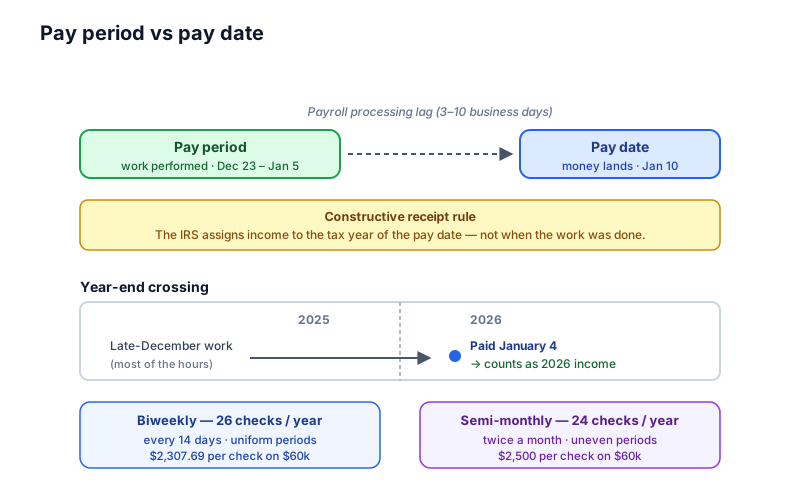
Pay Period vs Pay Date: The Core Distinction
The pay period is the span of dates you worked; the pay date is when the money lands. The two are routinely a week or more apart, and the IRS treats only the pay date as the date of income.
Consider a concrete example: you work December 23 through January 5, a two-week period straddling year-end. The gross earned covers thirteen workdays across both years. Payroll then takes time to process (timesheets are collected and approved, the payroll software runs, ACH transfers settle), and the check might not post until January 10. Same pay period, different tax year.
The IRS rule is called constructive receipt: income counts in the tax year it becomes available to you. For W-2 wage earners on cash-basis accounting (essentially all employees), that means the pay date. A check posting January 10, 2026 is 2026 income even if half the underlying work happened in December 2025.
A separate set of IRS rules governs how often employers must deposit the federal payroll taxes they withhold. Under IRS Publication 15, employers fall into either a monthly or semiweekly deposit schedule, with classification based on the total tax reported during a four-quarter lookback period (the $50,000 threshold splits monthly from semiweekly). Most small and mid-sized employers are monthly depositors; semiweekly applies to larger payrolls. A separate next-day deposit rule kicks in if an employer accumulates $100,000 or more of payroll tax liability on any single day, regardless of their normal schedule.
Why the Lag Between Pay Period and Pay Date
Most companies build in a three-to-ten-day gap between the close of a pay period and the matching pay date, and the length of that gap depends on how the payroll is structured.
Hourly work creates the longest lag because timesheets have to be collected, approved, and run through the payroll system before deposits can be initiated. A pay period ending Friday, December 29 may not produce a deposit until the following Thursday or Friday. Direct-deposit timing is also constrained by NACHA's ACH operating rules: same-day ACH has submission deadlines at 10:30 a.m., 2:45 p.m., and 4:45 p.m. ET, and a transfer initiated after the last cutoff settles the next business day.
Salaried workers move faster because hours don't need to be collected, making a one- or two-day lag common. A salaried employee might see a January 6 deposit for a pay period ending January 4. Semi-monthly pay dates aligned to the 1st and 15th are popular partly because they keep payroll predictable for both finance and employees.
Cash flow plays a role as well. Employers running payroll on the 15th and last day of the month need funds in the operating account on those dates, and a few days of buffer after period close gives finance time to confirm balances. The federal deposit clock is separate but related: a late payroll-tax deposit triggers IRS penalties that scale with how late the deposit is.
Bi-Weekly vs Semi-Monthly: 26 Paychecks vs 24
Biweekly means every 14 days; semi-monthly means twice a calendar month. The two schedules produce a different number of checks per year and different paycheck rhythms.
Biweekly pay produces 26 checks (52 weeks divided by 2), each covering exactly 14 days. Hourly and overtime-eligible workers are most often on biweekly schedules. A typical pattern is Sunday-through-Saturday work paid the following Friday, a three-to-five-day lag. California Labor Code §204 sets specific payday rules: for weekly and biweekly pay periods, wages earned must be paid within seven days of the close of the period. The semi-monthly version of §204 is different: wages for work performed between the 1st and 15th must be paid no later than the 26th of the same month, and wages for the 16th through the end of the month must be paid by the 10th of the following month.
Semi-monthly pay produces 24 checks (12 months times 2), most commonly on the 1st and 15th or the 15th and the last day of the month. Salaried workers are more often on semi-monthly. The period lengths are unequal (a 1st-15th period is 15 days, a 16th-end-of-month period is 13 to 16 days depending on the month), but the rhythm is predictable, and lag is usually one to three days.
A $60,000 annual salary works out to $2,307.69 biweekly across 26 checks or $2,500 semi-monthly across 24. The yearly total is the same; only the per-check amount and the date pattern differ.
The 27-Paycheck Year Quirk
Roughly once every eleven years, the biweekly calendar produces a 27th paycheck in a single tax year. The 14-day cycle doesn't divide evenly into 365 days (or 366 in leap years), so the count drifts: most years are 26 checks, and occasional years pick up a 27th.
The mechanics depend on where pay dates fall relative to January 1. A worker on a Sunday-through-Saturday biweekly cycle paid the following Friday will receive 27 checks in a tax year only if the first and last Fridays of the year both fall within the calendar year and the spacing works out. Payroll teams and HR expect 27-check years and plan around them; for employees, the practical effect is a single extra paycheck in that year.
The 27th check matters for withholding because the IRS withholding tables (and most W-4 logic) assume 26 biweekly periods or 24 semi-monthly periods. An extra check means slightly less tax was withheld per check than the annual brackets imply, so a worker on a normal W-4 may end up under-withheld by a small amount and owe a modest balance at filing. For high earners approaching the Social Security wage base of $184,500 (2026) or the Medicare IRMAA threshold that affects Part B and Part D premiums in retirement, the extra check can also be enough to nudge them across a planning threshold.
A 25-check year is rare but possible when a calendar shift moves what would have been a December 2026 check into early January 2027 (constructive receipt counts the check in the later year). In that case the 2026 W-2 shows 25 checks worth of wages, and the 2027 W-2 picks up the displaced check plus the normal 26.
Pay Date Determines the Tax Year at Year-End
The pay date, not the pay period, determines the tax year. A check issued January 3, 2026 is 2026 income even if the pay period ran December 20, 2025 through January 2 and 75% of the work was done in 2025. This result follows from the constructive receipt doctrine in IRS Publication 538.
Some employers deliberately stagger year-end paychecks to shift them into January: if the normal pay date would be December 31, they push it to January 2, and that entire check (including wages for December work) becomes next-year income. Employers sometimes do this intentionally to spread income across two years or manage cash flow, particularly when operating on a non-calendar fiscal year.
More often the shift is unintentional. A December paycheck sitting in the processing queue past year-end due to the normal lag, combined with the Christmas and New Year holiday break, can push a deposit that would ordinarily land December 27 all the way to January 6. When that happens, the check counts as the following year's income even though every hour of work it covers was performed in December.
A Worked Example: Year-End Pay Date Implication
Take a worker earning $100,000 annually on biweekly pay, so each check is $3,846.15. The final pay period of 2026 ends Saturday, December 26. The normal pay date is the following Friday, January 1, 2027, but because January 1 is a federal holiday, the deposit shifts to Monday, January 4, 2027.
That December-period check posts January 4, 2027, which makes it 2027 income under constructive receipt. The 2026 W-2 doesn't include it; the 2027 W-2 does.
The arithmetic: 2026 is a normal 26-check year for this worker, so the 2026 W-2 shows 26 × $3,846.15 = $99,999.90 — essentially the full $100,000 salary. 2027 is where the calendar bites: the January 1 check for the late-December 2026 period lands in the same year as a December 31, 2027 payday, so the 2027 W-2 runs long at 27 checks totaling $103,846.05. Annual gross averages out across the two years, but the IRS reporting and any income-tested thresholds (IRMAA, ACA marketplace subsidies, IRA contribution phase-outs) track the calendar year reported on the W-2. Matching your final pay stub to your W-2 at year-end is the cleanest way to verify the count.
This kind of shift creates real friction at transitions. A worker retiring December 31, 2026 with a final January 4 check sees that check land in 2027 W-2 wages, which may push 2027 income above an IRMAA threshold or affect a Roth conversion plan. Changing jobs mid-year compounds the problem: each employer withholds independently against its own pay-date count, so workers with two W-2s in the same year frequently end up under-withheld unless the Step 2 multi-job worksheet on the W-4 is filled in correctly at the new job.
Planning for Multi-Employer Tax Situations
A mid-year job change makes the pay date rule more complicated in a specific way. Work at Company A through September 30 and start at Company B on October 1; Company A's final check (for work through September) posts October 8, and Company B's first check (for October 1-15 work) posts October 23. Both deposits fall in October, so both are October 2026 income on paper even though they cover different months of work.
On the 2026 return, both employers file W-2s reporting all checks they issued in the calendar year, and the combined gross is the year's wage income.
Each employer withholds independently based on the information available to it. Form W-4 Step 2 helps account for multiple jobs; skipping that step can cause under-withholding, especially when both jobs pay similar amounts.
Pay Date Decides the Tax Year
The IRS tracks income by pay date, not pay period. Gross wages and withholding land in the tax year the check posts, regardless of when the work happened, so December work paid in January is next year's income.
Most workers see 26 biweekly or 24 semi-monthly checks in a typical year, with the occasional 27-check year creating a small federal-withholding mismatch that surfaces at filing. Anyone planning around an income threshold (IRMAA, ACA subsidies, retirement income limits) should account for year-end pay date timing explicitly, because the difference between a December 28 pay date and a January 4 pay date can move tens of thousands of dollars across a tax-year boundary.