How to Verify a Pay Stub Is Real: 7 Red Flags to Check
Prepared by Paystub Pilot
Compliance and legal research
Reviewed against fraud-prevention guidance from FTC, CFPB, and lender underwriting handbooks.
Landlords, lenders, and employers rely on pay stubs to verify income. Here are the math checks, document checks, and verification steps that still catch forged stubs.
Who Checks Pay Stubs, and Why
Pay stubs show up in lending, rental, and hiring decisions. Landlords use them to screen tenants, lenders use them to underwrite mortgages, and employers sometimes cross-check them during background verification. That makes them worth forging.
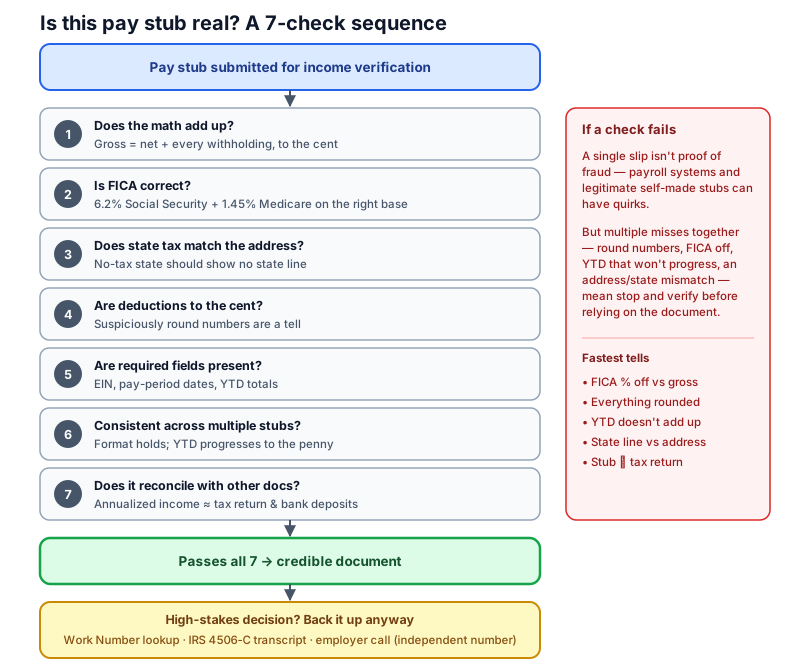
Landlords often start with visual inspection of the numbers, then escalate to direct employer calls or third-party verification services if the math seems off. You don't have to become a payroll examiner to verify a pay stub is real: the checks below catch documents that fail basic arithmetic or do not line up with the rest of the file.
One thing to keep in mind throughout: a single odd-looking detail rarely proves anything. Real payroll systems misfire, and honest applicants have unusual circumstances. What gives a forgery away is a combination of problems, so treat each red flag below as a reason to look closer, not as a verdict on its own.
That said, don't conflate fraud with legitimacy. Self-generated pay stubs created by freelancers and small business owners are legal and increasingly common. Fraudulent ones are not.
Red Flags That Indicate a Fake Pay Stub
1. Math That Doesn't Add Up
Math errors catch many fakes. Legitimate payroll systems calculate taxes and YTD totals to the cent using consistent rounding rules. Manual edits usually slip here, especially when someone changes gross pay without recalculating every dependent line.
Start with gross pay: hourly rate times hours (or annual salary divided by 26 pay periods) must match exactly. Then confirm net pay equals gross minus all withholdings by adding the deductions back; net plus deductions should equal gross to the penny. Year-to-date totals are the next check: the prior stub's YTD plus the current period's withholdings must equal the current YTD with no rounding. Finally, watch for jumps in YTD deduction totals; predictable increments mean the numbers weren't touched after the fact.
A common example: $3,000 gross, $400 federal, $200 state, $200 FICA, $2,200 net. The deductions sum to $800, so net appears to check out, but the FICA line is wrong (see red flag #2 for the correct calculation). A real ADP stub reproduces to the cent under the same employee profile and YTD starting point.
Most forgers bump the gross without touching the deductions, or vice versa. Those mismatches cascade across YTD totals and are trivial to spot.
2. Unrealistic Tax Withholdings
Tax withholdings are not random. Income, filing status, pay frequency, state, and year-to-date wages produce a predictable range. FICA is the fastest check because the rates are simple and visible: Social Security is 6.2% of gross (capped at $184,500 in 2026) and Medicare is 1.45%. On $3,000 gross, that works out to ($3,000 × 0.062) + ($3,000 × 0.0145) = $229.50. A figure of $228 or $230 is acceptable rounding; $150 or $350 is not.
Federal income tax depends on filing status, the W-4 inputs, and the pay frequency. A reasonable sanity-check range for a single filer at $5,000 biweekly ($130,000 annualized) in 2026 is roughly $700--$850 of federal income tax withheld per pay period, based on the percentage method tables in Pub 15-T applied to the 2026 brackets and the $16,100 standard deduction. A stub showing $100 in federal withholding at that income level is not slightly low. It is a flag worth investigating, often pointing to a fabricated document or an unusual W-4 exemption claim that the applicant should be able to explain.
State income tax must align with the residence and work-state addresses on the stub. A California resident working in California should show CA state withholding; a Florida resident working in Florida should not show any state line at all because Florida has no individual income tax. A mismatch between state code and stated address is a tell.
Five minutes with an IRS withholding calculator or a public payroll calculator settles most quick verifications. For a mortgage or rental decision where the stakes are larger, an IRS transcript ordered through Form 4506-C gives the IRS's own record of filed wages.
3. Rounded Numbers Everywhere
Payroll engines spit out odd numbers ($254.42 federal, $78.37 state) because they apply rate tables and percentage calculations to the cent. A $52,000 annual salary produces $2,000 biweekly gross, and from there the software generates figures like $254.42 federal, $78.37 state, and net pay of $1,514.21. Note that FICA on that $2,000 gross follows the same math shown in red flag #2, not a round figure.
Contrast that with a forged stub reading $3,000 gross, $500 federal, $200 state, $200 FICA, $2,100 net. Every figure is round, with none of the cents-level variation real payroll calculations produce. Tax brackets and percentage-of-gross math force that asymmetry, which is hard to replicate when someone is typing figures in by hand.
One important exception: gross pay can legitimately be round (annual salary divided by 26 pay periods often yields $2,000 or $3,000 exactly). A round gross alone is not a flag. What matters is whether multiple deduction lines are also round and net pay comes out clean. When gross, multiple deductions, and net are all suspiciously tidy on the same stub, that combination is what raises the question.
4. Formatting and Spelling Errors
ADP, Paychex, Gusto, and QuickBooks Payroll render to consistent templates. Fonts, logos, column alignment, and spacing stay the same from one stub to the next because the output comes from the same software build. Manual PDFs drift. Typos like "Fedral" or "Socail" are impossible in a real payroll system that has spell-checked field labels baked into its template. Beyond spelling, look for font chaos (inconsistent sizes or weights within a single stub), misaligned columns, wonky spacing, or a pixelated company logo that was clearly pasted in. A vague company name with no EIN is also worth noting; legitimate stubs always carry the employer identification number.
Three or more of those issues on one document point toward something assembled in Word or a PDF editor rather than exported from payroll software.
5. Missing Information
Real stubs carry the full set: employee name and address, employer name and address, EIN, pay period dates, pay date, gross, line-by-line deductions, net, and YTD totals. A missing EIN, a vague company address, or absent pay period dates is the kind of gap that justifies a deeper check, and several gaps at once on the same stub is harder to wave away.
6. Inconsistencies Across Multiple Stubs
Pull two or three stubs from the same applicant and check for font changes, employer address differences between stub 2 and stub 3, or layout shifts; any of those is a red flag. YTD numbers should climb predictably: stub 2's YTD should equal stub 1's YTD plus period 2's withholdings, to the penny.
7. Income Doesn't Match Other Documentation
Stubs should reconcile to the rest of the applicant's file. Bank statement deposits should land within rounding error of the stub's net pay. The annualized stub gross (biweekly gross × 26, or monthly × 12) should be in the same neighborhood as the applicant's tax return. A stub annualizing to $156,000 against a tax return showing $40,000 of W-2 wages is a problem that needs an explanation before the file moves forward.
How to Verify a Pay Stub: Methods That Work
Direct Employer Verification
Calling the employer is the lowest-effort verification step. Use a phone number you looked up independently rather than the one printed on the stub, ask for the employee by name, and confirm dates of employment and the approximate compensation level. A clean five-minute call resolves most ambiguous files.
For larger employers, The Work Number (Equifax) is the dominant third-party employer-side verification database, with direct payroll-system integrations across most large U.S. employers. Coverage varies by employer. Not every payroll provider feeds data to The Work Number (Workday's integration in particular is not universal across customers), so a Work Number miss isn't itself proof of a fake stub.
IRS Income Verification
For applications where higher confidence is warranted, an IRS transcript ordered through Form 4506-C (the form used by lenders via the IVES program; the older 4506-T is largely retired for lender use) returns the IRS's record of filed wages. Turnaround on IVES requests is often same-day to a few business days, making it the cleanest comparison for documents an applicant supplies in connection with credit, rental, or sponsorship applications.
Bank Statement Cross-Reference
Cross net pay on stubs against bank statement deposits. They should match or come within rounding error unless the applicant has split deposit, side income, or unusual deductions they have not disclosed. If the stub says $2,500 net and the deposit is $1,800, ask for the missing context before relying on it.
Third-Party Verification Services
Truework, Plaid Income, and Argyle hook into payroll systems, bank feeds, or tax data. They are not perfect and coverage varies, but they reduce the amount of manual document review a landlord or lender has to do.
What Legitimate Self-Generated Pay Stubs Look Like
Freelancers and small business owners sometimes create their own pay-stub-style income summaries. This can be legal when the document is labeled honestly and tied to real bank deposits, invoices, and tax records. A self-generated summary is not the same thing as an employer-issued payroll record, but it faces the same red-flag checks listed above: correct math to the cent, FICA and income-tax withholdings at current 2026 rates, required fields present, layout consistent, and annualized figures that reconcile to bank statements and tax returns.
A pay stub from Paystub Pilot or a similar generator should be checked the same way: checkable math, current tax rules, and consistency with source records.