W-2 vs 1099: Understanding the Difference for Pay Stubs
Prepared by Paystub Pilot
Payroll and tax research
Reviewed against IRS classification guidance, SE Tax instructions, and mileage guidance.
W-2 and 1099 income produce different tax records, different pay-stub formats, and different verification files. This guide walks through each difference.
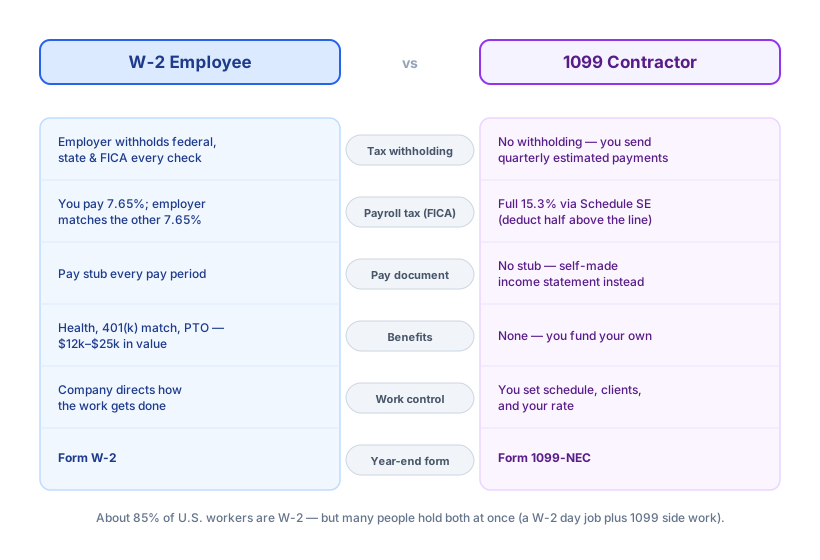 Side-by-side comparison of W-2 employees and 1099 contractors across tax withholding, FICA, pay document, benefits, work control, and year-end form
Employment Type Fundamentals: W-2 vs 1099
Employment classification affects taxes, benefits, and workplace rights, but a form does not choose the classification. The actual relationship must satisfy the applicable IRS, Department of Labor, and state tests.
An independent contractor usually receives gross payments without withholding and may receive a 1099-NEC if the payer and payments meet the reporting rules. (Employers and payers can produce the employee and recipient copies of both forms with the W-2 and 1099-NEC generators.) The contractor handles records, business expenses, income tax, and self-employment tax. Backup withholding and industry-specific rules are exceptions.
Many workers occupy both categories simultaneously, with a W-2 day job and 1099 freelance income on the side. The common mistake is neglecting to set aside taxes on the 1099 income, which produces an unexpected April liability when the Form 1040-ES quarterly payments were skipped. When the IRS evaluates whether a contractor is actually an employee, it applies three categories of common-law factors: behavioral control (does the company direct how the work gets done?), financial control (who supplies tools, sets the rate, and bears the risk?), and type of relationship (written contract, benefits, permanence, and whether the worker performs a core service of the business). Ambiguity often triggers a Form SS-8 determination request from either side.
W-2 Employment: Tax Withholding and Benefits
Your employer deducts federal, state, and FICA taxes from each check using your W-4, and also matches your Social Security and Medicare contribution dollar-for-dollar. Combined FICA is 15.3%; you pay 7.65% and the employer pays 7.65%, with only your half appearing on the stub.
Benefits can be a large part of compensation, but their value is offer-specific. Compare the employer-paid share of premiums, retirement match, paid leave, and insurance with the contractor's actual replacement cost.
The W-2 stub itemizes gross pay, applicable withholding, benefit deductions, and net pay. A worker can still need estimated payments when withholding is insufficient or other income is substantial. A self-employed worker calculates self-employment tax on Schedule SE and may deduct the employer-equivalent portion when calculating adjusted gross income.
1099 Contracting: Self-Employment Taxes and Responsibilities
A $5,000 contractor invoice often deposits as $5,000, but gross receipts are not taxable profit. Business expenses, filing status, other income, credits, and state rules all affect the final tax. Use Schedule C and Schedule SE or tax software rather than applying a single set-aside percentage to every contractor.
Calendar-year estimated-payment installments are generally due April 15, June 15, September 15, and January 15 of the following year, subject to weekend and holiday adjustments. The IRS resets the underpayment interest rate quarterly; it is 7% for July through September 2026. Professional help may be worthwhile when income is irregular, multi-state, or difficult to classify.
Health-insurance premiums and credits vary by age, income, household, plan, and location. Contractors also fund their own retirement and unpaid leave. Ordinary and necessary business expenses may reduce Schedule C profit, but personal expenses do not become deductible simply because the worker is self-employed.
W-2 vs 1099 Pay Stub Differences: What Appears on Each
A W-2 stub shows gross pay, federal withholding, state withholding, 6.2% Social Security, 1.45% Medicare, benefit deductions, and net pay, with year-to-date totals alongside each figure. The employer issues a new stub every pay period so the worker can verify the math. For a closer look at what each field means, see our pay stub fields glossary.
Contractors generally do not receive stubs from clients and often do not generate them either. A self-employment income statement (what tools like Paystub Pilot produce) shows gross receipts with no withholding and no FICA line, because neither was taken. Taxes remain the contractor's responsibility, not the payer's. Workers with both W-2 and 1099 income will have traditional stubs from the employer alongside self-employment statements or invoices from contract clients.
Mortgage underwriters and landlords treat these documents differently. A self-employment income statement is not employer-issued evidence and usually will not satisfy a lender on its own. Required history and documents vary by loan program and borrower, but tax returns or transcripts, a year-to-date profit-and-loss statement, and supporting business records are common.
Tax Implications: Which Type Costs More?
On $60,000 of Social Security and Medicare wages, a W-2 employee pays $4,590 in FICA and the employer generally pays the same amount. If a contractor has $60,000 of net self-employment profit and no W-2 wages, 92.35% is generally subject to the 15.3% rate, producing about $8,478 of self-employment tax before any Additional Medicare Tax. Gross receipts cannot be compared directly because business expenses reduce net profit.
Income tax rates are identical at the bracket level for both classifications. The 1099 advantage appears in deductions: half of the SE tax reduces AGI, and genuine business expenses (home office percentage, software, equipment, professional development, and mileage at the IRS business standard mileage rate) reduce business income before tax is calculated. For 2026, that mileage rate is 72.5¢ per mile for January through June and 76¢ per mile for July through December. Ten thousand dollars in legitimate deductions on a $60,000 gross brings taxable business income to $50,000, a reduction unavailable to a W-2 employee.
A complete comparison adds the employer's actual benefit contribution and payroll-tax share to salary, then subtracts the contractor's business costs, insurance, retirement saving, and unpaid time. A worker with both W-2 wages and self-employment income calculates Schedule SE on the self-employment portion, with the Social Security wage-base calculation taking the W-2 wages into account.
Choosing Between W-2 and 1099: Decision Factors
W-2 employment suits workers who prioritize benefits, predictable cash flow, and delegated tax administration. Health insurance is provided, the 401(k) match is automatic, vacation is paid, and the April tax return is routine.
1099 contracting suits workers for whom flexibility and income control outweigh predictability. The contractor sets the rate, selects clients, and determines the schedule. Disciplined recordkeeping allows deductions to meaningfully reduce taxable income, though no employer will fund health insurance or retirement contributions.
A person can be an employee for one business and an independent contractor for another when each relationship is classified correctly. W-2 withholding may cover some tax on the self-employment income, but the worker should use the estimated-tax rules or adjust Form W-4 rather than assume it is enough.